cena stellata in cantina

Proud to participate as technical sponsor in the event on the eve of San Lorenzo “Durello sotto le stelle”.

Saturday 9 August gourmet appointment at the “Gianni Tessari” cellar in Roncà with the starred chef of Degusto Matteo Grandi.

The protagonists of the event are Durello wine and the “street food” proposals of the young Veronese chef, who for the occasion will prepare artisan bread with our flours in our laboratory in Arcole.

Our desire to restart the territory lights up like the night of San Lorenzo! For more information and to book your participation, call 045-74600700 or write to officine@giannitessari.wine.

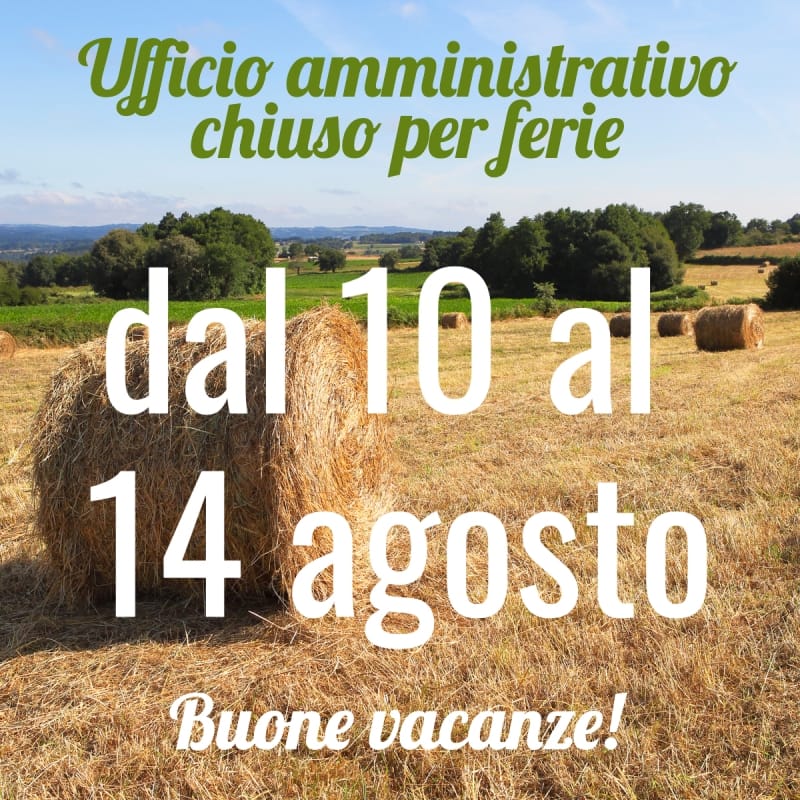
We inform all our customers, suppliers and collaborators that our administrative office will close from 10 to 14 August. We will be operational again from Monday 17th August.

Happy mid-August to all!


dolcetti-fichi-freschi

Sweets with fresh figs, delicious biscuits filled with a sweet autumn compote, a simple and delicious recipe to greet the arrival of September!

Since the temperatures are slightly lowering, we can find the courage to turn on the oven (don’t worry, half an hour will be enough)

For the shortcrust pastry
330 g flour type “0” Bio pastry core for shortcrust pastry and biscuits
100 g granulated sugar
60 ml sunflower oil
2 eggs
1 vanillin sachet
1 teaspoon of baking powder

For the fig filling
6-7 large figs
1 tablespoon granulated sugar
6 ladyfingers
Dry biscuits type Oro Saiwa

Method
Prepare the dough by putting all the ingredients together in a bowl and forming a nice firm and homogeneous ball. There is no need for resting times, as oil was used instead of butter.
Peel and chop the figs and cook them in a non-stick pan with the sugar, until compote.
Pulverize the biscuits with the mixer and put them in the fig compote.
With a rolling pin, roll the pastry into a rectangular shape, roll out a long strip of fig mixture to form a cylinder, closing underneath, as is done with strudel.
Cut the sweets so that they measure about 5 cm, place them on the dripping pan, lined with cartaforno.
Bake the cookies at 180 degrees for 15 minutes in a preheated oven, until golden brown.
Remove from the oven, allow to cool, sprinkle with icing sugar (to taste) and serve.

An excellent variant is also the addition of sliced ​​almonds, both on the surface and inside the compote. Almonds, like figs, are also a typical fruit of the month of September.

Beneficial properties of the fig: this small late summer fruit contains a lot of water and precious minerals such as calcium, phosphorus, magnesium, potassium, sodium and iron. Additionally, fresh figs are rich in vitamins A, B1, B2, B6, PP and C.

(Source: Il Giornale del Cibo)

Mid-morning snack: what are the best foods to take to school?

Schools are starting up again and with them the hope of a gradual return to “normality”.
One of the most debated topics among parents is how to keep their little ones healthy through nutrition, especially when they are away from home for many hours.


In this regard, we went to find an interesting article taken from the Gambero Rosso website, from which we have extrapolated some interesting ideas for the snack of half of the young students.

The article is based on an interview with two experts in the sector: nutritionist Tiziana Stallone and professor Fausto Aufieri of Vis Sanatrix Naturae, a nutritional biotherapy center in Rome.

In summary, these are the key points of the snack advice:

1) Yes to the savory snack, perhaps based on bread and oil or a breadstick wrapped in raw ham or bresaola.

2) Yes even to bread croutons soaked in egg and fried (in moderation!)

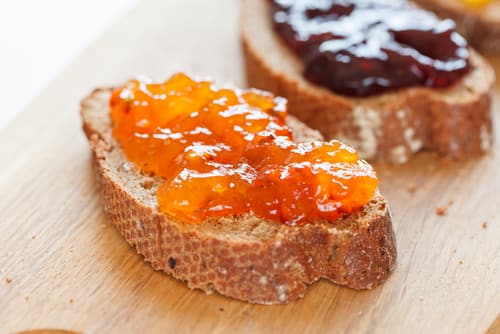
3) Yes to the classic donut and bread with jam, even with a sauce of butter (especially for athletes).
Bread with honey is also excellent!

4) Yes to fruit but not alone!

5) Yes to home-made drinks based on water and lemon slightly sweetened or sweetened with a little honey.
Yes to home-made herbal teas and karkadè.

5) No to packaged snacks that are too sweet or too salty or high in fat.

6) No to sweet drinks and no to fruit juices.

Below are the most interesting excerpts from the GR article.

The nutritionist comments on the mid-morning snack at school in this way: “Every child at school must have a mid-morning snack.

And if the snacks are abolished, what can be the best solution? “The ideal would be the snacks of the past such as panzanella, but also the classic bread and oil”, a perfect match for everyone’s diet, young and old (…) ”

Professor Aufiero, on the other hand, recommends breadsticks wrapped with a slice of raw ham or bresaola, “as long as they are of good quality” (…)

Another suggestion of Dr. Aufiero is to prepare fried croutons based on bread soaked in egg, “excellent because they have the egg proteins necessary for development, and because they are able to provide the right energy level to face the day”.

No absolute veto on frying, “to always be consumed in a moderate way”;

rather on sugar, another hot topic in childhood: “The real damage comes from solutions with a high glycemic index such as commercial fruit juices and various snacks”. (…)

Desserts, however, should not be abolished, but chosen with awareness. “If there is no diabetic inheritance in the child, the classic homemade donut can be an excellent solution for a snack”.

And to drink? “Slightly sweetened water and lemon, perhaps with a little honey, or herbal teas or karkadè, which children usually like a lot”.

Fruit plays a fundamental role, but not as a protagonist: “There is nothing more wrong than a fruit-only snack, which raises the glycemic index and often does not satisfy the child”.

Other sweet solutions? “Bread and honey, bread and jam, even with a layer of butter”, says Tiziana, “especially suitable for children who play sports thanks to its short-chain fatty acids, such as butyric acid”

If you are interested in reading the complete article you can find it on  site of Gambero Rosso on this link.

If you want to know the best flours to prepare an excellent snack for your children to take to school

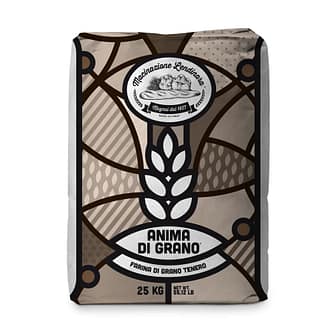
discover our line Anima 3Colori 100% Italian wheat for cakes and bread.

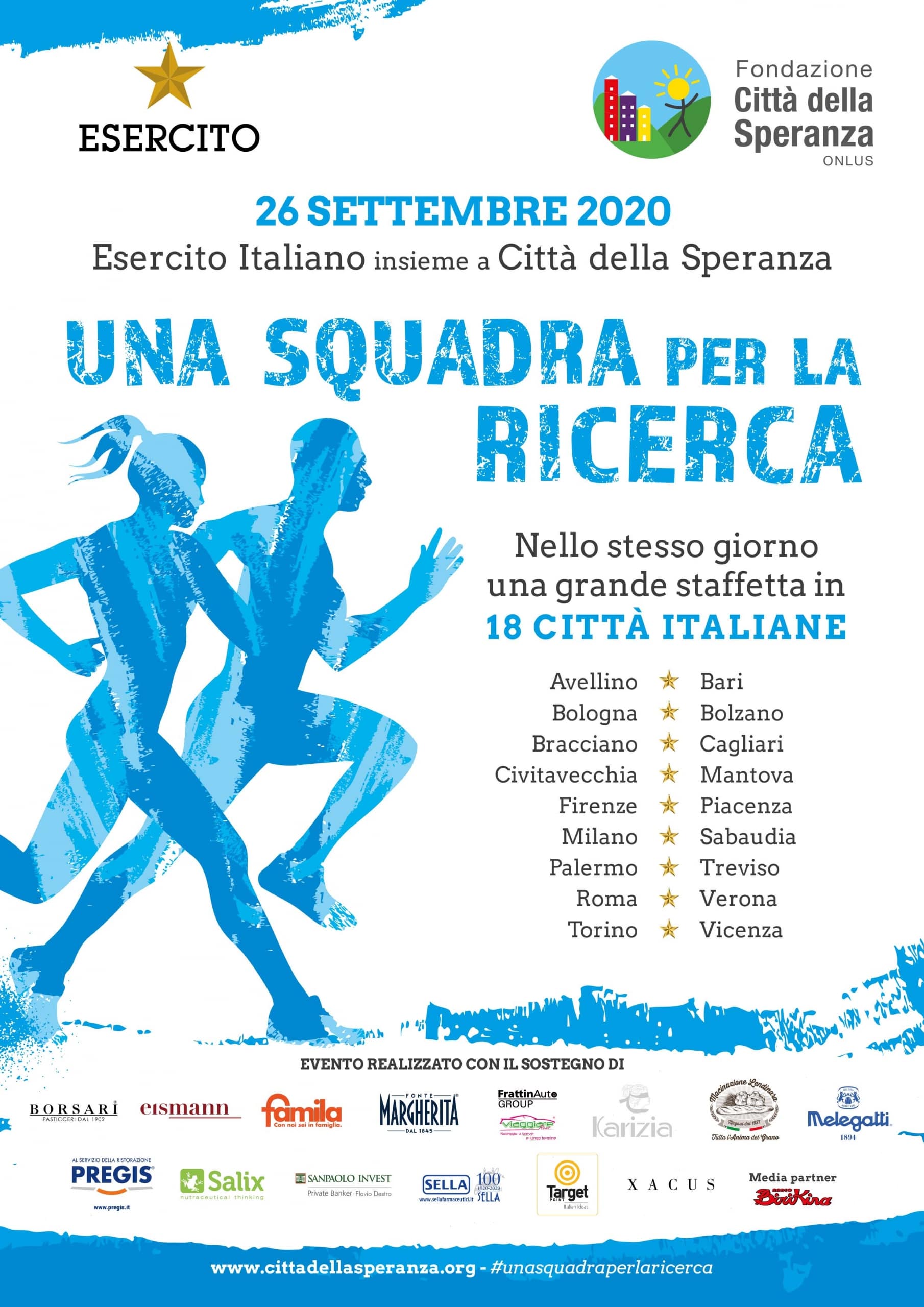
A research team: Italian Army relay in support of the Città della Speranza Foundation of Padua. We too have answered the call!

We are proud to promote the splendid initiative of the Padua Onlus which will take place on Saturday 26 September 2020 in many Italian cities.

This pandemic has highlighted three essential concepts: the importance of being an active part in the community, the pervasive force of solidarity and the need to face challenges with responsibility and civic sense.

The charity-sporting event A team for research will be held simultaneously in 18 cities, from north to south of Italy, to ideally embrace all children struggling with serious pathologies: Avellino, Bari, Bologna, Bolzano, Bracciano, Cagliari, Civitavecchia, Florence, Mantua, Milan, Piacenza, Palermo, Sabaudia, Rome, Treviso, Turin, Verona and Vicenza.

In each city, around specific ring routes, the members of one or more Army teams will alternate in the race (a total of about 350 people). The initiative will start at 8 am and will end at 8 pm and, in this time frame, each athlete will run for an exact hour. The sum of the kilometers traveled by all participants will be converted into a donation for Città della Speranza, thanks to the contribution of some supporters.

Some well-known sports champions and celebrities also married the initiative: the swimmer Massimiliano Rosolino, the marathon runner Gianni Poli, the middle distance record holder Gennaro Di Napoli, the showgirl and presenter Marina Graziani, the actor and TV presenter Dino Lanaro, the singer and musician Red Canzian.


More info: https://cittadellasperanza.org/


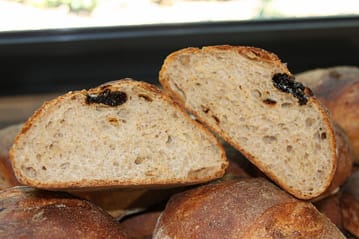
Walnut and plum bread to greet the summer season and celebrate the first day of autumn. Recipe for professional operators.

Discover our exclusive recipe made with Ryecorn, our new mixture of line Anima di Grano

with type “1” flour, rye flour and our special ingredient: toasted corn germ!

Ingredients

2 kg of Ryecorn Wheat Core Blend
80% water at 14 °
1% freeze-dried brewer’s yeast
4% freeze-dried mother yeast
2% salt
2% extra virgin olive oil
200 g shelled walnuts
250 g dehydrated pitted plums

pane-noce-prugne

Procedure (with mixer).
Mixing times: 8 minutes in first speed, 10 minutes in second speed.
Insert the fruits at the end of the mixture, turning the machine for 3 minutes.
Pasta temperature: 27 °.
Rest: 30 minutes.
Formation as desired, recommended minimum size of 200 g.
Rising 1 h and 20 minutes at 30 °, humidity 80%.
Cooking 230 °, steaming 3 seconds.

Training in the mill, we are ready to restart with courses dedicated to professional bakers.

pani fermentati e pani di grossa pezzatura


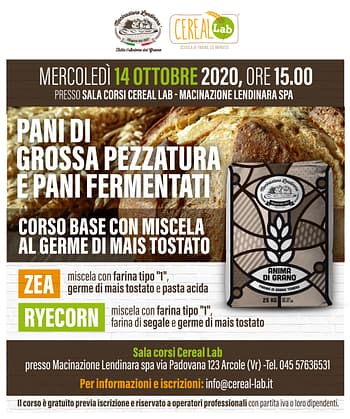
The first date is Wednesday 14 October at 3.00 pm at Cereal Lab, the training room inside the mill, in via Padovana 123 Arcole (Vr).

The theme of the afternoon is large-sized breads and fermented breads, which will be made with our two blends based on toasted corn germ from the Anima di Grano line:

the Ryecorn blend (type “1” soft wheat flour, rye flour and toasted corn germ)

and Zea (type “1” soft wheat flour, sourdough and toasted corn germ).

Professor of the course the technologist and master of white art  Pier Angelo Della Bona,

international expert in doughs and leavened products, who will lead participants to discover the potential of these two new blends applied to special large-sized breads and breads made with ferment, a new frontier in the sector.

The second date will be Sunday 18 October at 9.00, at the laboratory of the technologist Fabrizio Fiorentini of the Panificio S. Agnese and Acqua e Farina, in viale Maestri del Lavoro 7, Rieti.

This last event, organized together with the Bakers Association of Rome and its province, will be an excursus on four types of different products:

pizza shovel with chariot;

slipper with chariot;

artisan baguette without mold;

pan soft and suitable for long storage.

Also in this case the master and trainer Fabrizio Fiorentini will use the flours and blends of our mill: Zea e Ryecorn, Anima 3Colori 100% grano italiano e Betaglù,

the innovative blend with beta-glucans, ideal for cholesterol control.

For more information on our courses send an e-mail to info@cereal-lab.it, the mailbox of our training center.


Have you ever seen how an artisanal panettone is born?

In our Cereal Lab training room we did the test and the results were nothing short of exciting!

come fare il panettone artigianale

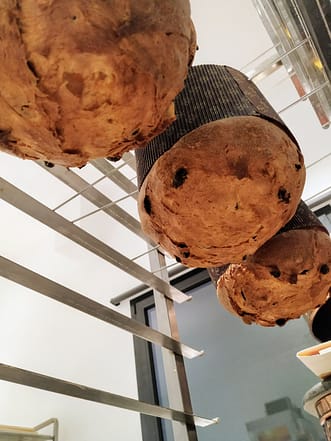
The pre-dough that rises slowly for at least twelve hours, the amazement after the night of leavening, the second dough phase and then the leavening again, the slow rest on the table, the overturns of the “pirlare” phase and finally the goal , the paper cups, where the last leavening phase takes place.

Finally, a light hand for the scarping with the scented butter and the longed-for reaching the oven from which, after about fifty minutes, we took out many small masterpieces.

For this magic you need many ingredients, all of top quality:

• Our flour of the line Anima di Pasticceria “Gran Riserva delle Feste”

• A technologist with golden hands, Pierangelo Della Bona

• An excellent instrumentation like that provided by our technical sponsors: the rotary kiln of Real Forni, the mixer Escher Mixers and the leavening compartment Pabatech.

An extraordinary host like Fabio Guzzano, who gave us this wonderful video and a review with laurels! If you want to read Fabio’s story about his two days experience with us click here

Here is the video that tells of our two days dedicated to panettone and … don’t be surprised if there are also images of pizza and bread: making panettone requires long waiting times, but we still found a way to use the time !


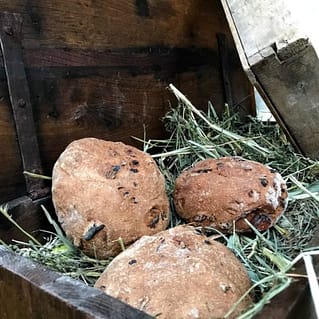
The micòoula is a typical Christmas bread from Hône, a village in the Aosta Valley and is the ideal recipe to make with our Ryecorn blend (type “1” wheat flour, rye flour and toasted corn germ).

amis della micooula

Foto dal sito https://www.amisdelamicooula.it/

Since 2008, a local association, the Amis della Micòoula, has decided to enhance this black bread with an unmistakable taste, which in the local dialect means “a little bit special bread”.

The aim of the members of the association is to rediscover the local tradition, to recover the fields and rural buildings – such as the mills, the ovens, the dryers – to re-evaluate the villages, the return of young people to their origins and above all the involvement of the whole community project linked to the territory.

We are fascinated by these local projects that take us back to the ancient with the awareness of the contemporary.

Below is the recipe, dedicated to the artisans who use our blend and who wish to try their hand at Micòoula.
Compared to the traditional recipe we have replaced the doses of wheat flour and rye flour with our Ryecorn.


Ingredients:

Ryecorn Wheat Core – Type “1” flour, rye flour, toasted corn germ

2 kg Ryecorn, 50 grams of yeast, 400 grams of boiled chestnuts, 150 grams of raisins, 100 grams of walnuts, 250 grams of dried figs, 1 liter of warm water, salt to taste.

Method:

Mix the Ryecorn with warm water, salt and yeast, and then knead.

Traditionally the mixing process is done by hand, in a wooden container. Always by tradition, cooking should be done in a wood oven, as Hône’s friends teach.

When the dough is ready, let it rest by covering it, then add the dried fruit and knead again.

Once this is done, long dough salamis are created which will then be cut and, with a movement of the hands, round spheres are created, about the size of an open hand.

Each loaf will have different dimensions and weight, since the process is carried out by hand without the aid of any machine; at this point, the loaves are baked.

After about 1 hour, the loaves are removed from the oven. To understand if the loaves are cooked to perfection, you need to beat them with your knuckles on the bottom: if they emit a dark and full sound, then cooking is the right one.

After beating, the loaves should be left to rest in a wooden container, until cooling, to ensure that the moisture still inside the loaf goes away.

Perhaps the most important trick is to salt the loaves, since they must not have any traces of sugar.


Fonti: Turismo.it, italianfoodexperience.it, amisdelamicooula.it